If you’re a Chevrolet owner who’s ever shopped for floor mats, you know the frustration of ordering a set online only to find they don’t fit right—too small to cover the high-wear area around your driver’s seat, or edges that curl up after a month of use. As a Chevrolet floor mats supplier who’s been working with GM models for 12 years, I’ve seen this mistake time and again. The good news? Measuring your Chevy correctly doesn’t have to be complicated. It just means ditching the guesswork and following a few clear, model-specific steps that work for every Chevrolet lineup, from compact hatchbacks to full-size Silverado pickups. Chevrolet Floor Mats

First, let’s talk about why generic measurements don’t work for Chevys. Each Chevy model has a unique floor pan shape: the Silverado 1500 has a deep recess for the driver’s side dead pedal, the Bolt EV’s flat floor leaves less room for mat overlap, and the Suburban’s third-row floor has a cutout for the rear AC vent. Ordering a “one-size-fits-all” mat almost guarantees gaps where dirt, water, and debris can seep into your carpet. That’s why taking 5 minutes to measure your specific Chevy will save you from headaches down the road—and give you mats that last as long as your vehicle.
Let’s start with the basics: what tools you’ll need. You don’t need fancy equipment here. A soft measuring tape (not a rigid ruler, since floor pans have curves and indentations), a piece of paper and a pen, and maybe a phone to snap quick photos of the floor shape (we’ll get to why that helps). Avoid metal tapes, as they can catch on floor seams or give inaccurate readings on angled surfaces.
Next, break this down by the three key mats you’ll need: driver’s side, passenger’s side, and rear bench or second-row (depending on your Chevy’s configuration). Let’s walk through each one step by step, with model-specific notes that matter.
Starting with the driver’s side mat—this is the most important, because it takes the most abuse from shoes, spills, and shifting during driving. Here’s how to measure it:
- Clear the floor: Remove any existing mats, floor liners, or debris from the driver’s side floor pan. Don’t skip this step—even a small piece of old mat under your feet can throw off your measurement.
- Measure length first: Start at the back of the gas pedal (if you have an automatic) or the footwell’s rearmost point (if manual) and run the tape straight forward to the point where the floor meets the bottom of the driver’s seat back. For Chevys like the Malibu, this point is often a raised seam near the seat base—don’t measure to the seat itself, because mat edges shouldn’t lie under the seat (that creates bunching).
- Measure width: The widest part of the driver’s floor is usually near the door sill, where your foot enters the car. Start at the inner edge of the floor pan (the side closest to the center console) and measure all the way out to the outer edge, where the door closes. For Silverado or Colorado truck models, add an extra 1-2 inches to the width to cover the recess around the dead pedal—many first-time buyers miss this cutout, leading to ill-fitting mats that leave the dead pedal exposed.
- Mark any cutouts: If your Chevy has a dead pedal (most trucks and SUVs do), a seat track opening, or a floor hook for securing the mat, draw that shape onto your paper. This helps when we cut custom mats to fit your exact pan—no guesswork on where the holes need to be.
Now the passenger’s side mat. This is simpler, but still has Chevy-specific nuances. For most sedans and hatchbacks (Sonic, Cruze, Bolt), the passenger’s side floor is wider at the front, near the glove box, than at the back. Measure from the back of the passenger side brake pedal (or footwell rearmost point) to the front edge near the door sill, and width from center console to outer door edge. For full-size SUVs like the Tahoe or Suburban, the passenger’s side may have a raised hump for the rear heater core—make sure to measure around that hump, not just straight across, to avoid a mat that sits too high or doesn’t cover the hump.
The rear floor mats are where a lot of buyers go wrong, especially with 3-row Chevys like the Suburban or Traverse. For 2-row models (most compact sedans, Equinox, Trax), the rear floor is a single flat pan. Measure length from the back of the front seat’s base to the rearmost edge of the rear floor pan, and width from one side door sill to the other. For 3-row models with a removable second row, or models with a rear AC vent in the floor, measure the area where you’ll place the mat specifically—don’t measure the entire rear cargo area. If you’re buying mats for the third row in a Suburban, you’ll need to measure the floor between the rear wheel wells, which is narrower than the main rear floor, so that’s a separate measurement.
Wait a second—what if I have a Chevy with a center floor console or a 60/40 split rear seat? That’s a common question we get at the supplier, and it’s important to adjust your measurements here. For a 60/40 split rear seat, you might need two smaller rear mats instead of one large one. Measure the left and right sections separately: the 60 section is wider, the 40 is narrower, so cutting two mats instead of one means they’ll fit without bunching around the split. For models with a full-length center console (like the Camaro or Corvette), the passenger’s side mat will stop at the edge of the console, so make sure your width measurement ends there—adding extra width will just make the mat hang over the console and get stuck under the seat.
Now, let’s talk about common mistakes that even seasoned Chevy owners make. First, measuring to the seat instead of the floor pan. The floor pan is the hard metal or plastic base, so your mat should lay directly on that, not under the seat’s soft trim. If you measure to the seat, your mat will be too short and leave a gap at the back. Second, not accounting for floor curves. The Chevy Silverado’s driver’s floor curves up slightly at the front, so measuring straight across will give you a width that’s too small. Use your soft tape to follow that curve, and you’ll get a more accurate number. Third, ignoring model years. A 2018 Chevy Equinox has a slightly different floor pan than a 2023 Equinox—even within the same model, GM often makes small tweaks to interior design. That’s why it’s a good idea to note your model year (check your VIN, or look for the year on your door jamb sticker) when you order.
Once you have your measurements, what do you do next? If you’re ordering from a supplier who specializes in Chevys (that’s us, for the record), you can use our online measurement guide to input your numbers, or send them to our team for a quick check. We’ve worked with every Chevy model from 1995 to 2024, so we know exactly how each floor pan shapes up. For example, a 2020 Chevy Bolt EV has a unique flat floor that requires a mat with smaller side edges to fit around the battery tray, and we build our mats to account for that—something generic mat suppliers miss.
We also recommend double-checking your measurements. It’s easy to mix up inches, so measure each mat twice. If you’re unsure, snap a photo of your floor pan from above, with the tape laid next to the edges. Our design team uses these photos to create a 3D model of your mat, so we can make sure every cutout, curve, and seam is perfect. We don’t mass-produce one-size-fits-all mats—each set is cut to your exact Chevy’s specs, because that’s what Chevy owners deserve.
At the end of the day, floor mats are more than just a accessory—they protect your original carpet from stains, tears, and wear that can cost hundreds of dollars to replace. For a Chevy, which is built for adventure, from work sites to road trips, having mats that fit right means you can spill coffee on the way to a job, track mud from a weekend hike, and not worry about ruining the interior. We’ve had customers tell us that their custom-fit Chevy mats have lasted 7 years or more, because they don’t shift, curl, or gap like generic ones.
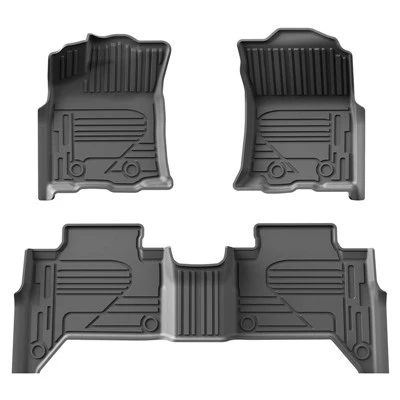
If you’re ready to get the perfect set of floor mats for your Chevrolet, don’t leave it to chance. Use the steps we’ve outlined here, share your measurements and model year with our team, and we’ll work with you to create a set that fits like it was made for your exact vehicle. No more returns, no more frustration—just mats that work as hard as your Chevy does. Reach out to our team to discuss your needs and get a custom quote tailored to your model.
Ram Floor Mats References
- GM Interior Dimensions Database, General Motors LLC, 2024
- Automotive Floor Fit Measurement Standards, National Automotive Parts Association (NAPA), 2023
- Chevy Model-Specific Interior Panels, GM Product Documentation, 2022
- Custom Floor Mat Manufacturing Best Practices, Automotive Aftermarket Industry Association (AAIA), 2021
Zhejiang Kangyu Automobile Parts Co., Ltd.
Zhejiang Kangyu Automobile Parts Co., Ltd. is one of the most professional chevrolet floor mats manufacturers and suppliers in China, also supports high quality customized service. We warmly welcome you to wholesale CE and ISO approved chevrolet floor mats from our factory. Also, 6 years warranty is available.
Address: No.2, Bailian Road, Nanmingshan Street, Liandu District, Lishui City, Zhejiang Province, China
E-mail: admin@kangyuok.com
WebSite: https://www.kangyucarmat.com/
